‘Missing Mile’ of Gloucestershire Canal to be Restored

Part of the Stroudwater Navigation that was lost to road builders half a century ago and is now due to be reopened will be designed by property, construction and infrastructure consultancy Perfect Circle and its extensive supply chain.

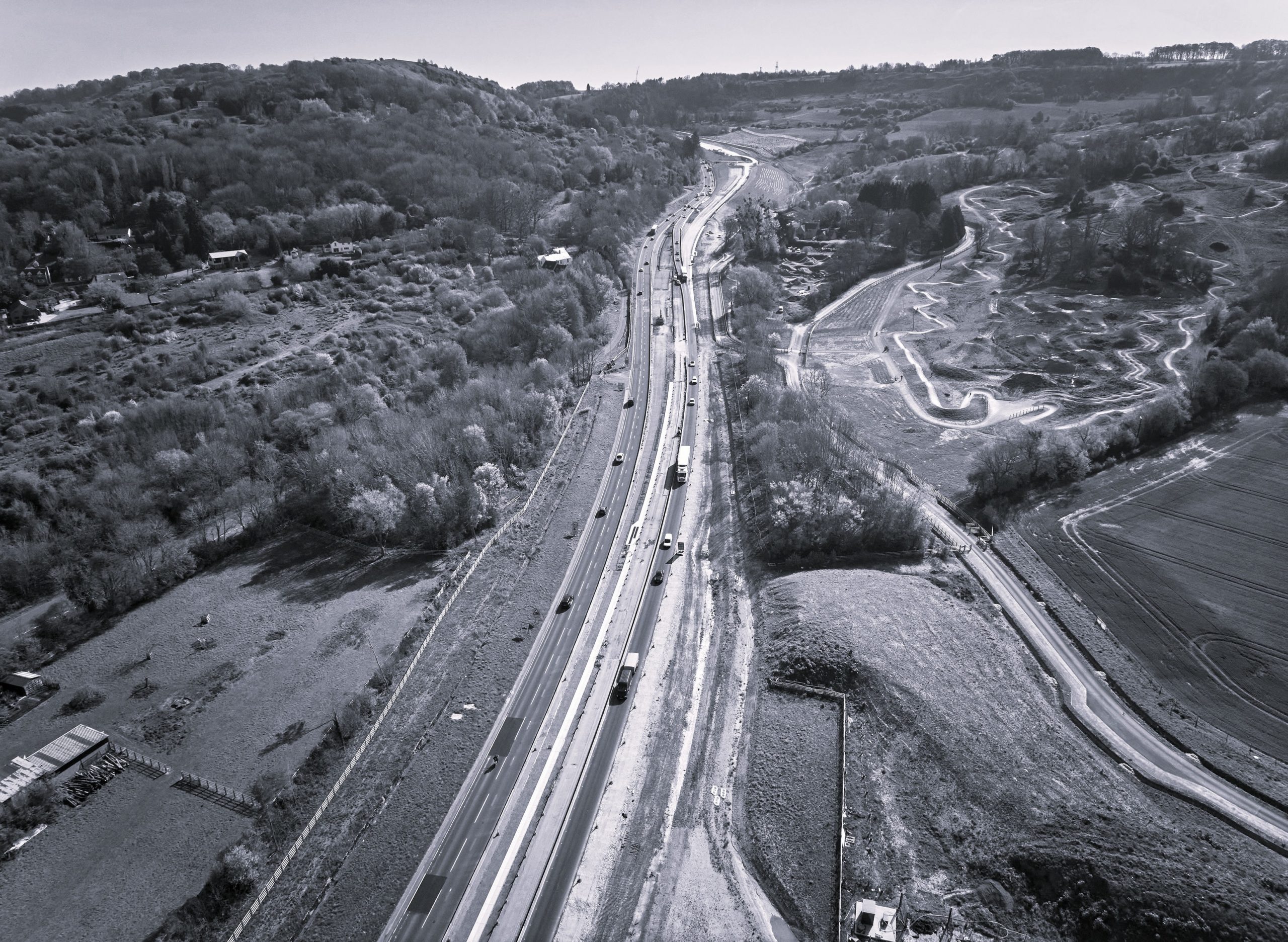
Following the Act of Abandonment 1954, a mile long section of the Stroudwater Navigation was destroyed to make way for the A38 roundabout, A419 link road and the M5 in the late 1960s. This section now forms one part of the Cotswold Canals Connected Phase 1B Restoration Project, locally known as the ‘Missing Mile’.

The section of canal through the A38 Whitminster Roundabout has recently been reinstated, thanks to National Highways Designated Funds, who granted The Cotswold Canals Trust £4m towards the ‘Missing Mile’. The next step in this restoration will be to excavate a new canal channel along with the construction of two new locks, one new lift bridge, accessible towpath, flood relief, lowland habitat and wetlands.

Further along the Stroudwater Navigation volunteers will continue to lead the restoration and maintenance and look forward to the canal between Thrupp (near Stroud) and Saul Junction being re-connected to the 2,500km of inland waterways network at Saul Junction.

As a preferred partner of Perfect Circle, Tony Gee has been commissioned to deliver preliminary design, detailed design and on-site supervisory services via SCAPE Consultancy – a direct award framework that drives collaboration, efficiency, time and cost savings. It is our first appointment as part of Perfect Circle.

Tara-Leigh McVey, infrastructure framework director at Perfect Circle, said:We are delighted that Stroud District Council, on behalf of Cotswold Canals Connected has engaged Tony Gee and Partners via Perfect Circle and SCAPE Consultancy to help reinstate part of Stroudwater Navigation that was lost more than 50 years ago.

Waterways are vital for providing economic, social and environmental benefits; as well as being catalysts for regeneration and development, they play a major role in improving the wellbeing, inclusion and prospects of communities. This project will not only help reconnect the ‘Missing Mile’ to the national canal network, but it will provide an accessible walking and cycling route, which will attract more visitors to the area and support the local economy.

Peter Reeves-Toy, director at Tony Gee, said:This crucial project will enhance the cultural heritage, environmental and historic features near the M5 and A38, as well as increase biodiversity, providing over 21 hectares of new habitat. As part of our works, we will be providing preliminary design services for the whole ‘Missing Mile’, including the highway interface with the A419 (where a new mooring basin will be created), the canal, two new locks, pedestrian bridge and the underpass beneath the M5 motorway, as well as the excavation of the canal itself.

“Not only is the project interesting due to the heritage of the canal and the importance of waterways to communities, but from an engineering perspective, it’s a real technical challenge. To avoid the disruption and cost caused by constructing a purpose-built canal crossing beneath the M5, the existing underpass used by the River Frome will be used to create a new canal channel alongside the river, albeit with a lower water level than the river to provide the necessary headroom.

The Company of Proprietors of The Stroudwater Navigation were authorised by Act of Parliament in 1730 to build the canal, which opened in 1779. It connected the market town of Stroud, in Gloucestershire, to the River Severn, with its main cargo being coal. Following the opening of the Thames and Severn Canal in 1789, it formed part of a through-route from Bristol to London.

Due to competition from the railways and the Act of Abandonment granted in 1954, permission was given to release part of the Stroudwater channel, including Bristol Road Lock, to enable the construction of the M5 link road and the A38 roundabout.

The ‘Missing Mile’ is one of 40 major engineering and restoration projects that together form the Cotswold Canals Connected Phase 1B (a partnership project led by Stroud District Council and the Cotswold Canals Trust; together with other key organisations including Stroud Valleys Canal Company, Gloucestershire County Council, Gloucestershire Wildlife Trust and Stroudwater Navigation Archive Charity) they are preserving the heritage and building the future of the historic canal corridor.

Glenn Dooley, Cotswold Canals Engineering Manager, said: “Working through the SCAPE framework has provided the opportunity to engage with the professional services of local consultants, Tony Gee & Partners. Their team is based alongside the project and therefore understand the importance of this project to the local community and the benefits the restoration will provide”.

The SCAPE Consultancy framework offers direct access to the most extensive property, construction and infrastructure consultancy services available to the Public Sector. The procurement route brings together the strongest collaborative team with value for money, while contributing substantially to local social value.

Mark Robinson, group chief executive at SCAPE, said: “Reinstating the ‘Missing Mile’ on the Stroudwater Navigation will bring back to life a lost piece of history and make it an asset for modern times, boosting the local economy and environment. Tony Gee and Partners via Perfect Circle and Cotswold Canals Connected Partnership are creating a public amenity that won’t just bring pleasure to the local community but give wildlife a safe haven through biodiverse environments. We are very proud to be helping accelerate this project and look forward to seeing it progress.”

For more information on Perfect Circle, please visit www.perfectcircle.co.uk.

Tony Gee is Carbon Neutral and commits to carbon reduction investment plan

Tony Gee's 2020 carbon emissions footprint has been externally verified and certified as Carbon Neutral.

Tony Gee’s 2020 carbon emissions footprint has been externally verified and certified as Carbon Neutral. Alongside this, with a view to future proof their carbon emissions going forward, Tony Gee has also introduced an annual carbon investment to ensure that their operational emissions each year are offset. This practise will continue at a fixed rate over time with the view of achieving a carbon negative status as their processes and supply chain carbon emissions are better defined and targeted for reduction.

Tony Gee’s 2020 carbon emissions footprint has been externally verified and certified as Carbon Neutral by Carbon Footprint Ltd

In 2019 Tony Gee signed up to the Pledge to Net Zero campaign and they have been developing their operational carbon monitoring capabilities in house since.

To take their work to the next level they have had their stated emissions externally verified. Working with Carbon Footprint Ltd, they firstly had their measurement tool and methodology verified, and then they went through a process of checking their monitored data to validate their stated emissions. This has now been completed and Tony Gee has an externally verified operational carbon footprint. They then purchased high quality carbon offsets to cover the emissions for the year.

Tony Gee’s assessments to date do not yet include commuting and the emissions associated with working from home. However, they have started to estimate these and are planning to bring this into their reported emissions in future years as they move to more hybrid working.

Tony Gee has also been engaged with their upwards supply chain and have reported these figures to clients that accounted for over half of their 2020 turnover to help them with their foot printing exercises. Tony Gee is committed to helping their upwards supply chain and will provide the data to all clients when they require it.

Chris Young, Executive Managing Director, said:
Climate change is almost certainly the biggest threat we have ever faced and as a business we are proud to have signed up to the pledge to net zero. Signing up is only the first stage though so it is great see that we are already making positive steps to reduce and offset our own carbon footprint.

I also offer up the invitation to our clients, these internal company measures and targets are a good first step for Tony Gee but the impact of our designs will dwarf any savings we make to our own company emission, so if you think our designs are not addressing the issues or we could do better on sustainability and carbon reduction challenge us on this every time and we will work with you to make your projects better!

Tony Gee’s verified emissions for 2020 are summarised in the below infographic. Commuting and working from home emissions are in the process of being estimated and will be included in reported figures in future years.

Tony Gee introduces an annual carbon investment going forward

Tony Gee know that carbon offsetting is not the answer to the climate emergency that the world is facing.
There is awareness that they cannot rely on offsetting to replace reducing their emissions. Tony Gee is continually striving to reduce actual emissions using the IEMA carbon reduction hierarchy as shown below in the high level Carbon Plan.
However – offsetting is widely regarded to have a positive impact if done correctly. Tony Gee has partnered with Carbon Footprint Ltd to ensure that they only purchase high quality and effective verified offsets.

The offsetting options used provide positive steps to reducing carbon. Tony Gee has therefore made the decision to commit to an annual ‘carbon investment’ per employee of 2 tonnes CO2e. This quantity has been based on an amount sufficient to offset our predicted carbon footprint, as well as provide additional investment in carbon mitigations going forwards.

The intention of this is to firstly offset Tony Gee’s operational emissions each year (running offices, business travel, WFH emissions and commuting). It is intended that there will then be a residual net negative offset amount left. There will be other emissions that are not yet picking up in monitoring, particularly in the supply chain, so they are hesitant to claim being carbon negative at this point.

Keeping the ‘investment’ per staff member the same year on year means that as Tony Gee reduce their absolute emissions, the gap (and the ‘carbon negative’ figure) will increase year on year, having an increasingly positive impact as time goes on. This positive impact will increase too as the business grows in size.

Tony Gee propose to apply the carbon investment across the UK and international business. This investment this will help to reduce their impact whilst work is being done to establish more reliable monitoring of international operational emissions.

This graph indicates the intention of the carbon budget plan. Tony Gee will review the investment amount periodically as their footprint assessments evolve.

Tony Gee Launches Carbon Calculator to SMEs

Tony Gee is giving away its in-house embodied carbon calculator to small and medium size organisations throughout the construction industry to support the discussions at the COP26 climate change conference being held in Glasgow this month.

Tony Gee is giving away its in-house embodied carbon calculator to small and medium size organisations throughout the construction industry to support the discussions at the COP26 climate change conference being held in Glasgow this month.

Having grown from an SME ourselves, Tony Gee fully recognises the challenges this size organisation can face. Many smaller companies lack the time and resource to develop their own in-house tools, such as carbon calculators. The climate change emergency is too important for anybody to be left out of the conversation and having every organisation invent the same wheel to do the job of assessing carbon is an unnecessary hurdle to progress on this issue.

SMEs represent a large percentage of the industry.  The donation of the tool is intended to stimulate and sustain the carbon agenda at all levels of the industry, not just the large and well-resourced corporations. Carbon must become part of everyday business for all organisations involved in the purchasing, design and specification of products and services in the construction industry. Having a simple tool to assess carbon on even the smallest projects can support the discussion of carbon impacts in the design process, but also with clients.

To use the carbon calculator please download it using the link below and join us in working to the challenge of net zero.

The carbon calculator is provided for guidance. It is based on information freely available in the public domain. Whilst every effort has been made to assure the accuracy of the calculator, it is incumbent on the user to check their output with the source data and verify that their calculations are correct.

Click to download the Carbon Calculator spreadsheet